
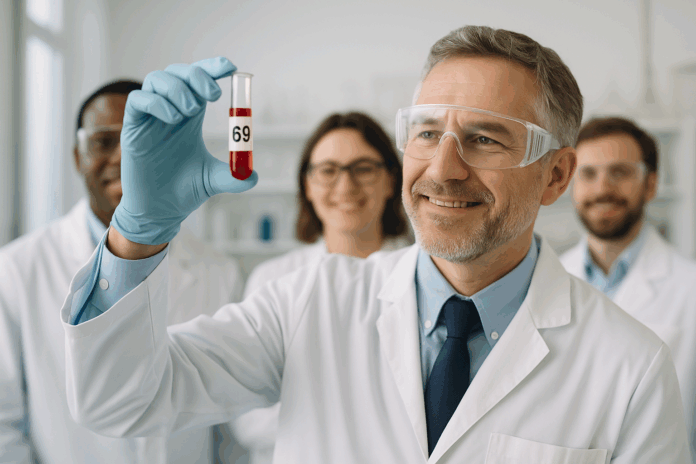

RALEIGH, NC — As Health Secretary Robert F. Kennedy Jr. pushes forward a proposal to ban Red 40 and eight other artificial food dyes, the original creators of Red 40 have quietly introduced a new option: Red 69, a newly formulated natural dye that promises the same color, health consciousness and an overall more mutually satisfying outcome for everyone involved.
Kennedy’s proposal, currently under FDA review, would restrict the use of several synthetic dyes including Yellow 5, Yellow 6, Blue 1, Blue 2, Green 3, Orange B, and Citrus Red 2, long used in everything from snack cakes to sports drinks. While these additives remain legal in the U.S., many are already banned in the European Union over health concerns.
“This isn’t about taking the fun out of food,” Kennedy said at a press briefing. “It’s about replacing 20th-century chemistry with 21st-century science. We have the tools now to make better choices without making kids eat what’s essentially flavored highlighter fluid.”
Red 69, developed by a team that includes several of Red 40’s original formulators, is positioned as that better choice. Derived from natural sources like beetroot, elderberry, and stabilized anthocyanins, it offers a near-identical color match with none of the petroleum-derived base.
“We knew the writing was on the wall for Red 40,” said Dr. Kip Vortmann, lead food pigment researcher at ColorDaddy Labs, the firm behind Red 69, who described the formula as “exciting, edgy and a safer alternative to the real stuff.”
“We didn’t just want to create a safer dye, we wanted something that would keep the revenue flowing,” Vortmann said. “Health-conscious doesn’t have to mean unprofitable.”
The lab insists the name Red 69 is purely coincidental. “It was the 69th iteration we tested. It stuck. That’s it. Any other associations are out of our control.”
So far, the new dye has passed all regulatory hurdles for GRAS (Generally Recognized As Safe) certification and is already being evaluated by several major food producers, particularly those in the children’s beverage and snack sectors, industries that have long relied on bold coloring to maintain shelf appeal in a hypercompetitive market. The first brand to officially test the dye is Gushers, which reportedly used Red 69 in a limited trial batch described internally as “visually compelling with a surprisingly flavorful finish.”
Still, Vortmann emphasizes that Red 69 isn’t designed to flood the market the way Red 40 did. “Due to the unknowns of the long-term effects, including possible addictive properties, we recommend using it sparingly. Think birthday products, holiday exclusives, or snacks consumers are just beginning to emotionally attach to.”
Public health advocates have cautiously praised the shift. “If companies are going to dye foods bright red, we’d prefer they do it with something that doesn’t come with a warning label in other countries,” said Marion Chalmers, a nutrition policy researcher. “It doesn’t solve the problem of over-processed food, but it puts the future of the American people in a solid position.”
Industry analysts agree that consumer expectations are shifting. “People are reading labels. ‘Natural coloring’ used to be a punchline. Now it’s a sales driver,” said Susan Delgado, a food industry consultant.
Some early marketing materials for Red 69 reportedly encourage brands to “color with intention,” a phrase meant to emphasize ingredient transparency, but one that, in at least one focus group, prompted an extended silence followed by someone whispering, “Nice.”
Red 69 isn’t widely available yet, but early prototypes are in circulation, primarily in products that want to take things slow and see where the shelf life goes.
In an industry built on sugar, salt, and attention spans, Red 69 offers something different, a coloring agent that isn’t here to dominate, just to be an option that’s always on the table.